
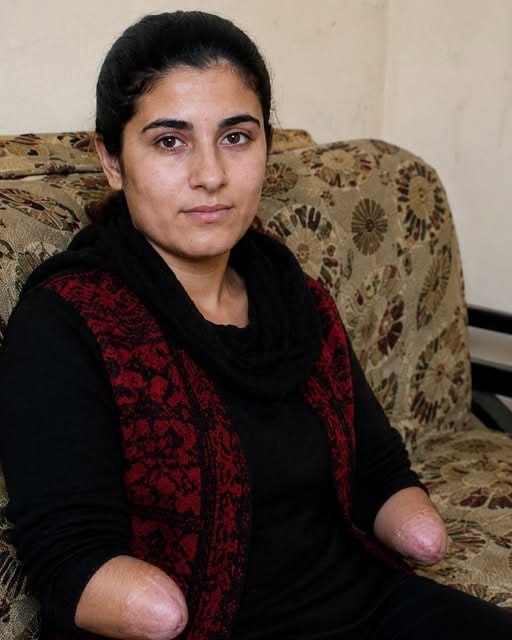
At 21, my husband took me to a field and cut off both my hands… But what happened next made an entire country remember my name.
I was twenty-one when I learned that the man who sleeps next to you can be more dangerous than any stranger.
My
name was Ayşe, and I had only been married for eight months. In our village, they still called me “the newlywed.” I was still learning to live in my husband’s house, to speak in hushed tones, to wake up before dawn, and to hide my fear before it appeared on my face.
My husband, Mehmet Ali, was not a kind man. At first, I didn’t call it cruelty. I called it a bad temper. I called it marriage, because that’s what many women around me had learned to call it.
If the food was late, I blamed myself. If his voice turned cold, I spoke even less. If he looked at me as if I belonged to him, I told myself that perhaps all husbands were like that when no one was watching.
Then came the wedding of the daughter of some neighbors.
In our village, weddings were a celebration
for everyone. The women brought food, blankets, flowers, and fabrics to decorate the bride’s room. Even poor families wanted their daughters to begin married life surrounded by color and hope.
That morning, my mother-in-law opened a trunk and handed me two pieces of fabric.
“Take this to the bride’s house,” he told me. “They can use it for decoration.”
I didn’t steal them. I didn’t hide them. I took them with her permission, thinking only that I was helping another young woman prepare for the happiest day of her life.
At the bride’s house, the women laughed, arranged pillows, hung fabrics on the walls, and teased the nervous bride affectionately. For a while, I forgot the heaviness of my own home. I laughed with them and felt like I belonged somewhere.
In the afternoon, Mehmet Ali found out about the fabrics.
When he got home, he didn’t scream. That scared me even more. He stood in the doorway and stared at me with a silence that chilled my hands.
Anatomy
—Where are the fabrics? —he asked.
“Your mother gave them to me,” I replied. “For the bride’s room.”
Her face changed.
—My mother doesn’t decide what comes out of my house.
My mother-in-law tried to intervene.
—I told him to take them.
He looked at her only once, and she remained silent.
That’s when I realized it had nothing to do with the fabrics. He was furious because I had done something without fearing him first.
A few minutes later, he ordered me to go with him.
“Where to?” I asked.
—To the countryside.
I wanted to refuse. I wanted to run back to the wedding house, where there were women, voices, and witnesses. But I was a young wife in a town where women were taught that disobeying their husbands could bring more shame than suffering because of it.
Real Estate Market
So I followed him.
The path seemed endless. Behind us, I could still hear the distant laughter from the wedding. With each step, those voices grew fainter, until only the wind, the dust, and the man walking beside me remained.
Then I saw what he was carrying.
A sharp farming tool.
My body understood before my mind could accept it. I told myself he just wanted to scare me. I repeated to myself that no man would actually destroy his wife over two pieces of cloth.
I was wrong.
When we arrived at the empty field, there was no one around. No woman. No neighbor. No one who could stand between his anger and me.
He turned to me and asked:
—Which hand did you use to hold the fabrics?
Anatomy
My mouth went dry.
—With the right hand—I whispered.
The way he looked at my hand revealed everything. He hadn’t brought me there to interrogate me. He had brought me there to punish me.
What happened next divided my life into two parts: the young woman who walked into that field and the woman who left there carried by other people.
I won’t describe every detail. Some cruelties are terrible enough without needing to be covered in blood. I remember falling. I remember the dirt against my dress. I remember looking at my husband, waiting to see remorse appear on his face.
He didn’t appear.
And in the midst of that commotion, I raised my other hand toward him and uttered the words that people would repeat for years:
—If you’re going to leave me like this, take this one too. What am I going to do in this world with only one hand?
Anatomy
For a second, I thought it would stop.
He didn’t.
When they found me, I was barely alive. The women screamed. Someone ran for help. Someone kept repeating my name over and over, as if they could keep me in this world by calling me back.
At the hospital they told me I had survived.
But when I opened my eyes and realized what had been taken from me, it didn’t feel like a miracle. My hands were gone. My marriage was over. The silent bride everyone had expected me to be had died in that field.
Anatomy.
But not me.
Mehmet Ali believed he had ended my life that day.
But what if the most terrifying thing for a cruel man is not the woman he destroys… but the woman who refuses to remain destroyed?
I’ve left the rest of the story in the first comment because Facebook won’t let me post it all here. What Ayşe did after waking up without her hands made an entire country speak her name with respect. That’s why I’ll leave the continuation in the comments 👉👉‼️‼️⬇️⬇️
If the link doesn’t appear, change your comment settings from “Most relevant” to “All comments”. 👇👇
PART 2
At first, I thought that surviving had been the hardest part.
But I was wrong.
The hardest part began after the hospital, when people looked at me with pity and whispered the same question everywhere I went:
—How will he live now?
My husband was arrested. The court punished him. People said that justice had been served.
Calculators and reference tools.
But justice didn’t help me get dressed.
He didn’t help me eat.
It didn’t stop me from waking up at night trying to reach for hands that were no longer there.
Many people thought my life was over. They expected me to sit in a corner, depend on others, and become a sad story the town would whisper about.
But he had already lost too much.
I refused to lose myself too.
So I started again.
Slowly.
Painfully.
I learned to use my arms and elbows. I learned to dress myself, cook, clean, wash, and carry objects in ways that people didn’t think were possible.
At first they looked at me with sadness.
Then, to my surprise.
And finally, with respect.
Linguistic resources
I didn’t want to beg. I didn’t want people to feed me because they felt sorry for me.
So he walked up to the mountains.
I gathered thyme, herbs, and wild figs. The bags were heavy. The paths were difficult. My whole body ached, but I carried everything to the market and sold it with dignity.
Philosophy
Some people bought me because they felt sorry for me.
Later on, they bought because they knew I had earned every penny with my own effort.
Years passed.
People came to hear my story. Mothers brought their daughters to me and said:
—Tell him what you survived.
But I never told my story just to make people cry.
She told the story so that women would understand that cruelty doesn’t begin in a field. It begins much earlier, in the anger that people justify, in the silence that women are forced to swallow, and in the first moment a wife begins to fear the man who should be protecting her.
Mehmet Ali had taken my hands away.
Military history.
But I hadn’t lost my dignity.
It hadn’t taken away my strength.
It hadn’t taken away my desire to live.
And that was the part he never managed to understand.
He wanted to see me defenseless.
Instead, I became proof that a woman can be hurt and still refuse to be defeated.
So tell me honestly… when a woman survives something that was meant to destroy her, should people only remember what was taken from her or the strength she built with what she had left?


0 comments:
Post a Comment